Rasmus Bruhn
The Hanging GirlRasmus Bruhn is a Danish citizen and former travel correspondent whose death in a drainpipe links an investigation in the Netherlands to earlier Danish murder cases. Identified after his body was recovered, he is presented not as a speaking character but through the conflicting traces of his public identity, criminal record, travels, and concealed connections.
Identification and public profile
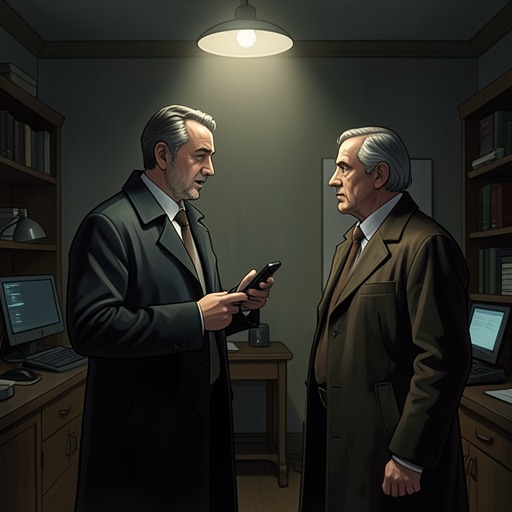
At a press conference, Terje Ploug showed a photograph of Bruhn: a balding man in his forties, with blue eyes and a distinctive, droll smile. His polished clothes—Ray-Ban sunglasses in his hair, a pressed white shirt, and a tailored-looking jacket—suggested someone intent on appearing in control. Police identified him as a forty-four-year-old Danish citizen living in the Netherlands, with several prior convictions. In recent years he had also worked as a journalist under the pseudonym Pete Boswell. That professional role gave him a mobile, outward-facing identity; the subsequent investigation would show that his work and extensive travels also made him relevant to inquiries into networks of people and messages.
Travel, Networks, and the Earlier Amager Case
Bruhn’s work as a travel correspondent gave investigators a practical reason to look beyond his residence in the Netherlands. Dutch colleagues reported that his journeys offered ample opportunity to act as a courier, particularly for precious stones, while the breadth of his contacts could have allowed him to connect people and relay messages. He had travelled through East Asia and the Middle East, as well as Africa and the Caribbean. These were investigative possibilities suggested by his occupation and reach, not proof that he had carried particular goods or messages.
His identity also reopened an older, unresolved thread in Denmark. Years earlier, during the demolition of the barrack on Amager where three Danish police officers had been shot, a dismembered body was found in a box. Police had associated that unidentified victim with the name Pete Boswell after receiving an anonymous tip. A fleur-de-lis branded on the dead man’s right shoulder gave the assumption support, although officials had not made it public and the medical examiners needed several days to verify the mark because of the body’s decomposition. At the press conference, Terje Ploug explained that the tip had ultimately proved misleading: Bruhn was known to have used the pseudonym, but that did not establish that the body found on Amager was his.
The findings from Bruhn’s death supplied a different chain of identification. His body had been in the water for several days, inside a drainpipe near the scene. Scratches on the pipe’s interior and silt disturbed at its bottom indicated that he had tried to pull himself free. He had been dressed young for his age and carried almost nothing, but a business card remained readable despite the time in the water. It led investigators to his home on Haverdreef, in De Akkers, just north of the crime scene.
Evidence at His Home and Danish Connections
The search of Bruhn’s home produced evidence that complicated the picture of a travel journalist whose contacts might have served as channels for couriers and messages. Investigators found a pistol with a full magazine and Bruhn’s fingerprints on it, 250 grams of poor-quality cocaine, and notebooks containing names. The objects established a criminal dimension to the inquiry, but the reported findings did not by themselves explain how each item related to his death or to the people listed in the notebooks.
One name connected Bruhn’s papers to a murder investigation in Sorø. The person was the younger of two men killed with a nail gun in a local car repair shop, and the nephew of a man whom Carl Mørck, Anker Høyer, and Hardy Henningsen had found murdered on Amager, a Paslode nail driven into his temple. Through this family connection, Bruhn’s Dutch residence and death became entangled with cases stretching back to the earlier killing on Amager. The connection widened the investigation, but did not establish that Bruhn had participated in either murder.
Bruhn’s name reached Carl Mørck again through television coverage of a press conference. When asked whether the murdered man in the drainpipe meant anything to him, Carl said he did not recognize the name; Mrs. Sørensen responded to his language with an eye-roll. The exchange leaves Bruhn’s significance suspended between what investigators had uncovered and what Carl could personally connect to him. His identity gave the inquiry new links to follow, while the press conference made clear that those links had not yet resolved the questions surrounding his death.
Narrative Function and Unresolved Significance
Bruhn enters the story through other people’s attempts to name him: a photograph at a press conference, a journalist’s pseudonym, an anonymous tip, and the objects recovered from his home. Those traces do not line up neatly. The name Pete Boswell had been attached to the dismembered body found on Amager, but the tip behind that identification proved misleading; Bruhn’s use of the same pseudonym did not establish that the corpse was his. The distinction turns an apparent identification into a warning about how easily a clue can harden into a story before it is verified.
His case also draws together lines of inquiry without settling them. The travel correspondent’s movements and contacts suggested possible courier work, while the pistol, cocaine, and notebooks opened further questions; the name connected to the notebooks, in turn, linked him to the Sorø nail-gun murders and the earlier Amager killing. Yet when Carl Mørck was asked about Bruhn, he said he did not recognize the name. Bruhn’s significance therefore lies in the pressure his scattered connections place on the investigation: they widen its reach, but leave his own role and the circumstances of his death unresolved.